Help with Trauma – Grounding
What do I need to do?
Grounding techniques are very personal. What works really well for you might not work for someone else- We have lots of suggestions below – try one out and see if it helps.
Grounding techniques also become easier with practice. Aim to do some every day or whenever you feel overwhelmed. Try different things out – but make sure you stop if the technique makes you feel worse or unsafe.
Mental techniques
These techniques help you to refocus your thoughts.
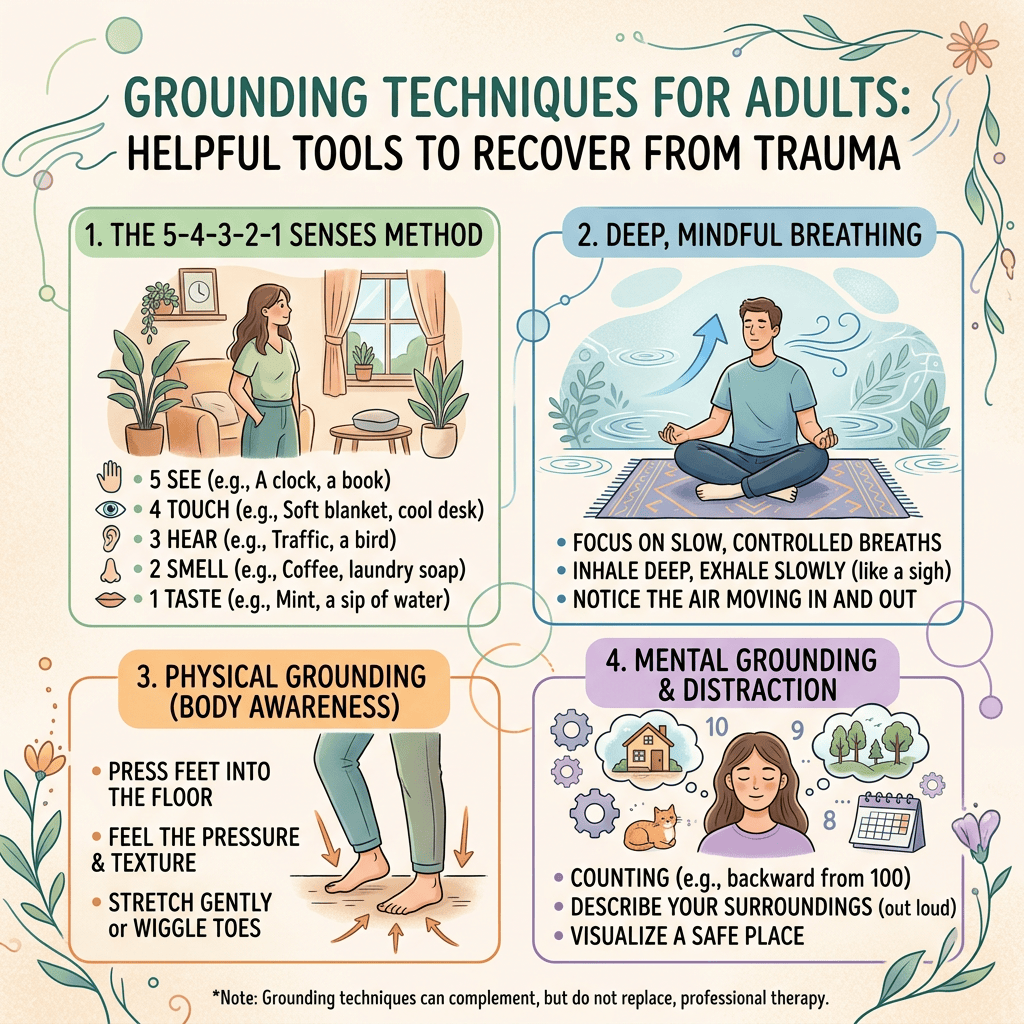
5-4-3-2-1
This technique helps you to focus your attention on the present:
- Name 5 things you can see
- Name 4 things you can feel (“my feet on the floor”)
- Name 3 things you can hear (“traffic outside”, “birds singing”)
- Name 2 things you can smell
- Name 1 thing you can taste
Alphabet game
Pick a category (e.g. ‘food’) and think of an item for every letter in the alphabet (e.g. apple, banana, crisps… etc).
Concentrate on a mental task
Complete a tricky mental task or calculation. For example:
- Go through your times tables (3 x 2 is…, 3 x 3 is…, etc)
- Say the alphabet backwards
- Do some challenging sums (19 x 21 = …)
Imagery
Visualise something that stops you from focusing on your unwanted thoughts or feelings. For example you could imagine:
- A big STOP sign
- Changing the ‘TV channel’
- ‘Turning down the dial’ on your emotions
Use an anchoring phrase
Describe who you are, how old you are, the date today, the time, where you are now.
For example, “My name is Emma, I am 57 years old. Today is Monday 23rd March, it’s 10am, I’m sat at my kitchen table.”
You can keep adding details until you feel better. “My tea is warm. I can hear the breeze outside. It’s my day off today.”
Physical techniques
These techniques help you to feel physically grounded and connected to your body.
Breathe
Pay attention to your breath. Inhale through your nose and out through your mouth. Place your hands on your belly. Watch as your hands move up and down as you breathe.
Touch a grounding object
Try carrying a small object in your pocket wherever you go – for example a small stone. Touch or grip this when you feel overwhelmed or triggered.
Dig your heels in
Concentrate on putting your weight into your heels. Remind yourself that you are physically connected to the ground. Stamp your feet if that helps.You could try it barefoot on a soft carpet or rug.
Tense and release
Try clenching and releasing your fists.
You can also tense up your entire body and focus on slowly releasing it, from the forehead, jaw, shoulders right down to your toes.
Touch or grip objects
Touch or grip different objects around you. Think about how they feel. Or try gripping onto your chair as hard as you can.
Wiggle and stretch
Stretch your arms and legs. Try wiggling your fingers or toes.
Soothing techniques
These techniques help you to feel calm, safe and relaxed.
Happy place
Think about a place you can relax, feel safe and be happy. It can be real or imagined. This could be a tropical beach, a cosy room with a log fire, high up on a mountain overlooking the world…it’s up to you.
Plan a treat
Think about a soothing, relaxing treat for later – for example a bubble bath, a nap under your favourite blanket, a or nice meal.
Coping statements
Repeat coping statements to yourself or write them down. For example, “I am strong”, “I have done this before”, “This too shall pass”.
Safety statements
Repeat safety statements to yourself or write them down. For example, “I am safe now”.
Self-kindness
Repeat kind, compassionate and encouraging statements to yourself or write them down.
For example, “I matter”, “I am having a tough time but I will get through this”, “I am trying hard and doing really well”.
What if it doesn’t work?
Lots of people who have experienced trauma say that grounding techniques can help. You don’t have to use the techniques we have suggested – there may be something that works better for you.
Remember, grounding becomes easier with practice. Try to use your technique regularly to see if it becomes more effective.
You can try checking in with yourself. Before you start a technique, score how you feel out of 10. After you have finished, score yourself again. What has changed? Has the technique helped you at all?



Leave a Reply