OCD is debilitating, can be paralysing and very distressing. I have worked with and helped many people of various ages with this problem. I have often been able to help them overcome these issues. This success comes with the guidance of what is known about what actually works. Feedback from a grateful client follows to illustrate:
“I had felt overwhelmed, angry and depressed. I feel so much happier now and have managed to overcome so many of my OCD cleaning issues with your help, in just 6 weeks. I am no longer constantly hoovering, picking up clothes, and am getting on so much better with my partner now. I don’t need to come any more” (Female 27yrs. Risk factor Core score had gone from 20 down to 5)
What is OCD?
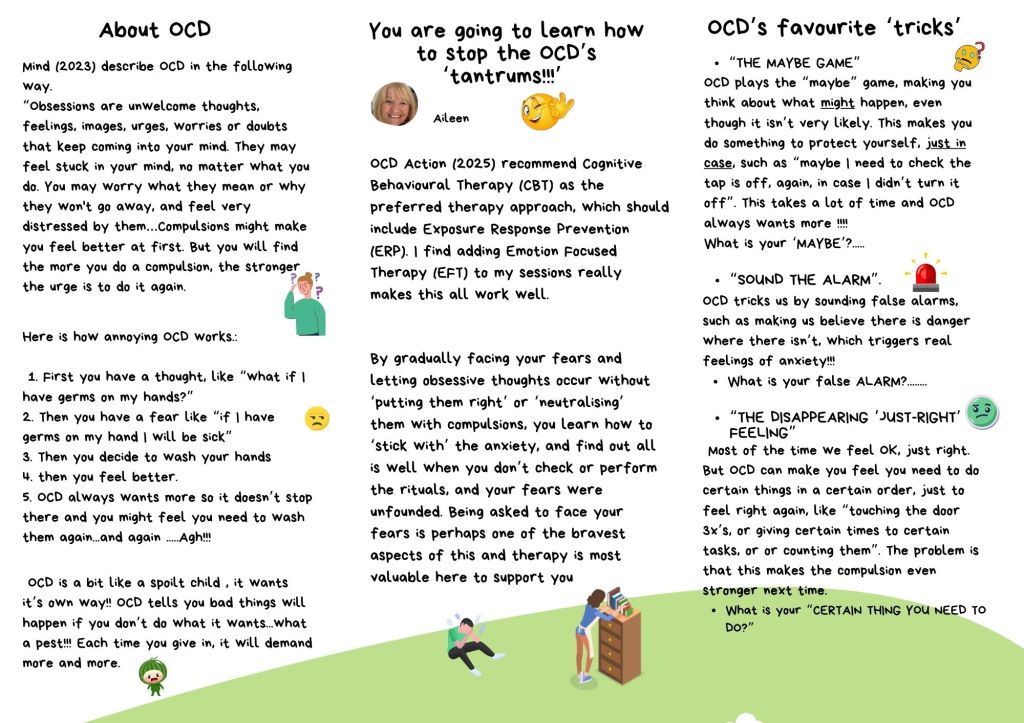
Mind (2023) describe OCD in the following way.
“Obsessions are unwelcome thoughts, feelings, images, urges, worries or doubts that keep coming into your mind. They may feel stuck in your mind, no matter what you do. You may worry what they mean or why they won’t go away, and feel very distressed by them…Compulsions might make you feel better at first. But you may find the more you do a compulsion, the stronger the urge is to do it again. Compulsions can be things you do physically, like repeatedly checking a door is locked. Or they can be things you do in your head, like repeating a specific word to yourself. Or they may involve others, such as asking people for reassurance. if you have OCD, your doubts and fears about your thoughts, and the things you do to feel better, can make you very distressed. And they can have a big impact on your life.” Mind (2023)
Approximately 1-2% of the population suffer with OCD… “OCD does not just affect the individual with the disorder but draws in their friends and families… OCD rituals can take a huge toll on family life and drive a wedge between them” (OCD Action 2025).
Helping overcome OCD with therapy
OCD Action (2025) recommend Cognitive Behavioural Therapy (CBT) as the preferred therapy approach, which should include Exposure Response Prevention (ERP). Drawing on their guidance, and other evidence-based sources of theory, I have found that therapy experience that works with clients looks like the following:
Content of sessions
The sessions should mostly stay focused on client’s OCD, how it works, and how they are challenging it.
Therapist Aided exposure
Clients are gradually encouraged to face their fears. They use ERP and a graded step by step exposure. Obsessive thoughts are let occur without ‘putting them right’ or ‘neutralising’ them with compulsions. Clients’ exposures would be done in the session with them wherever possible. This is to teach them how to ‘stick with’ the anxiety. We observe their reactions and encourage them. They are helped to find out what happens when they don’t check or perform the rituals, realising all is well, that their fears were unfounded. Being asked to face their fears is perhaps one of the bravest aspects of therapy, and is where the approach of the therapist is most valuable
Negotiated homework
Clients would also have exposures to go through at home, as well as some cognitive homework. These might include practicing observing certain things to reframe their thinking and help them understand their own OCD.
Stepping back from rituals
Client would be encouraged to resist compulsions as part of their day to day life. While exposures are an active challenge that pushes back against the OCD, it’s also important to use their increased resilience to reduce the rituals that make up their day.
Personal goals
The therapy revolves around their own personal goals, by listing the obsessions and compulsions and ranking them in order from worst to least problematic. I help clients work out what those goals are and keep focused on them as they move forward. These should be specific and achievable, and described in terms of what they will do
Setting the pace
The treatment should be intense enough that clients are challenging themselves and the OCD, but not so much that they get overwhelmed and can’t stick with it.” (OCD Action n.d. accessed 2025)
The emotional aspect
Whilst there is much theory that argues against the need to explore the emotional and historical aspect of a person’s experiences to help their struggle with OCD, I have found in practice, that this is not so. I argue that it is crucial element that will enable them to fully recover, and ought not to be ignored. This is because it helps them understand and unlock the self-compassion and understanding that is so important in facilitating real change that lasts. There is usually a ‘lightbulb moment’ when the client says something like “ah, so that is why I struggle with it so much”. Greenberg (2022) argues that enabling sufficient awareness of either sadness at loss or anger at violation is essential in treating depression and anxiety. These are the two key emotional problems of OCD. Accessing and restructuring these emotions are essential goals. He argues that anxiety occurs when a client is uncertain about their ability to manage a threat, which so resonates with the needs of someone with OCD, they react with anxiety or avoidance. I would agree.
I hope this summary of my approach, which draws on theory and practice, helps others.
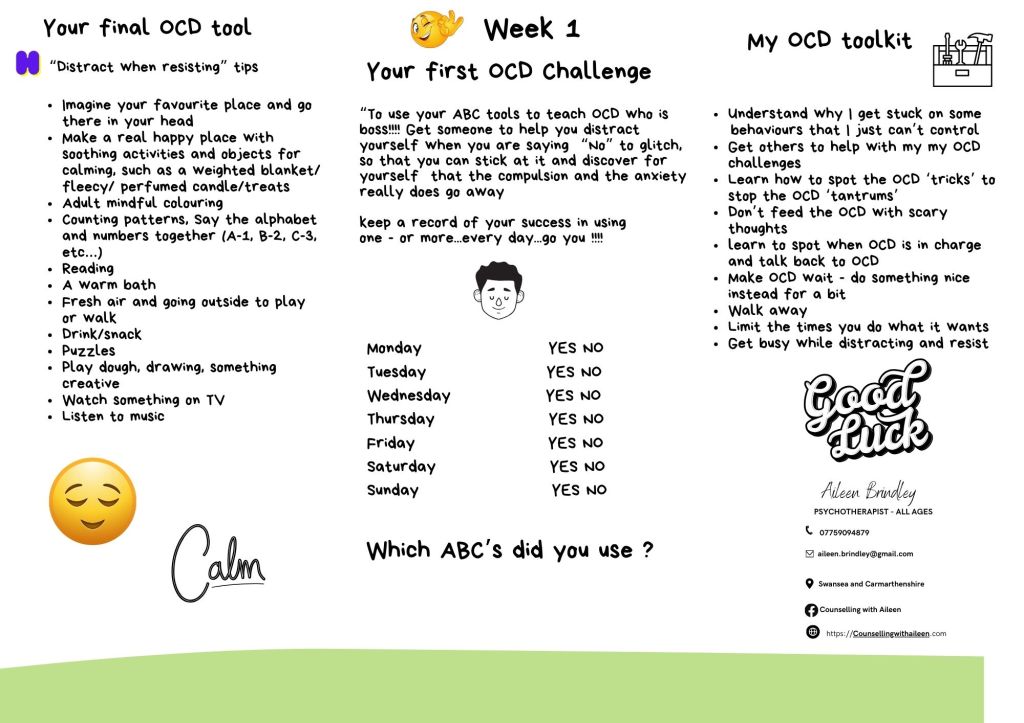
A leaflet you might find helpful

References
Information on effective therapy and support https://ocdaction.org.uk/resources/therapy accessed 26/01/25 (OCD Action, Accessed 12/01/25)
Mental health charities such as Mind have useful documentation and peer support https://www.mind.org.uk/information-support/types-of-mental-health-problems/obsessive-compulsive-disorder-ocd/about-ocd/ (MIND, October 23; accessed 25/01/25)
Organisations to challenge stigma such as such as “Time to Change Wales” are a good source of support for client https://www.timetochangewales.org.uk/en/
“Emotion-Focused Therapy: Coaching Clients to Work Through Their Feelings” (Leslie Greenberg 01/09/22) American Psychological Association; 2nd ed

 Counselling with Aileen
Leave a comment